ServicesShingle Roofing
Shingle Roofing in Carefree, AZ
We repair and install asphalt shingle roofs on pitched homes, from a handful of lifted tabs to a full tear-off. Before any work starts, you get a written scope naming the shingle line, underlayment, flashing and vent work, so you know exactly what you are paying for.
What a Shingle Roof Needs to Last Here
Asphalt shingles are built in layers: a fiberglass base, asphalt that keeps water out, and a surface of mineral granules. The granules work as sunscreen. When they wear away, UV hits the asphalt directly, its oils bake out, and the shingle stiffens, cups and cracks until the base shows through. Hard desert sun speeds all of that up, so attic airflow, shingle color and the state of the granule surface say more about remaining life than the install date does.
Shingles suit pitched roofs of roughly 4:12 and steeper, and they can go as low as 2:12 with a doubled underlayment. On shallower slopes we point you toward Flat Roofing or Foam Roofing instead. If your home already carries concrete or clay tile, our Tile Roofing page covers that system.
Every job begins with a written scope. It names each component and its quantity, and it sets unit prices for things nobody can see until the old roof is off, such as damaged decking. The final bill then matches the paper you signed.
What Our Shingle Work Covers
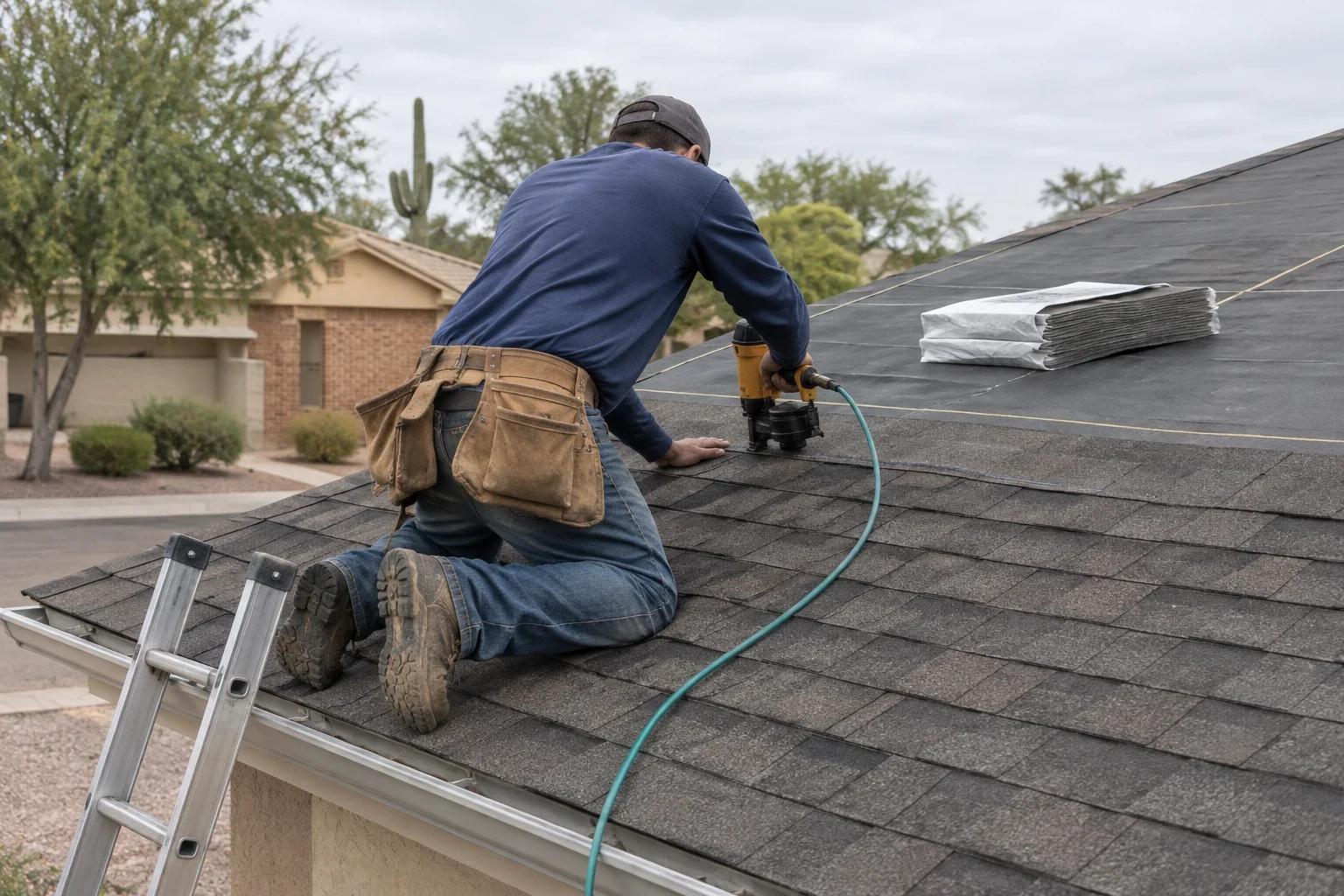
- Tear-off to the deck
- We strip old shingles, nails and felt down to the plywood or OSB. With the deck bare, we can find soft spots, separating layers and old leak stains instead of burying them.
- Underlayment and drip edge
- Synthetic underlayment covers the full deck, and metal drip edge runs along the eaves and rakes. Drip edge stops water from curling back under the first course and soaking the fascia board.
- Starter strip and wind nailing
- A dedicated starter course seals the first row at the eave. We follow the manufacturer's high-wind nailing pattern, which gives summer gusts less chance to peel tabs up.
- Flashing and pipe boots
- Step flashing where the roof meets a wall, new counterflashing where the old metal is tired, and fresh pipe boots. The rubber collar on a boot splits after years of direct sun, and it is one of the most common leak sources we find on shingle roofs.
- Attic airflow check
- Fresh air should enter low through the eave vents and leave high through a ridge vent or roof vents, and we measure whether those two sides are in proportion. When hot air has nowhere to go, the attic bakes the shingles from below while the sun works on them from above.
- Cleanup and magnet sweep
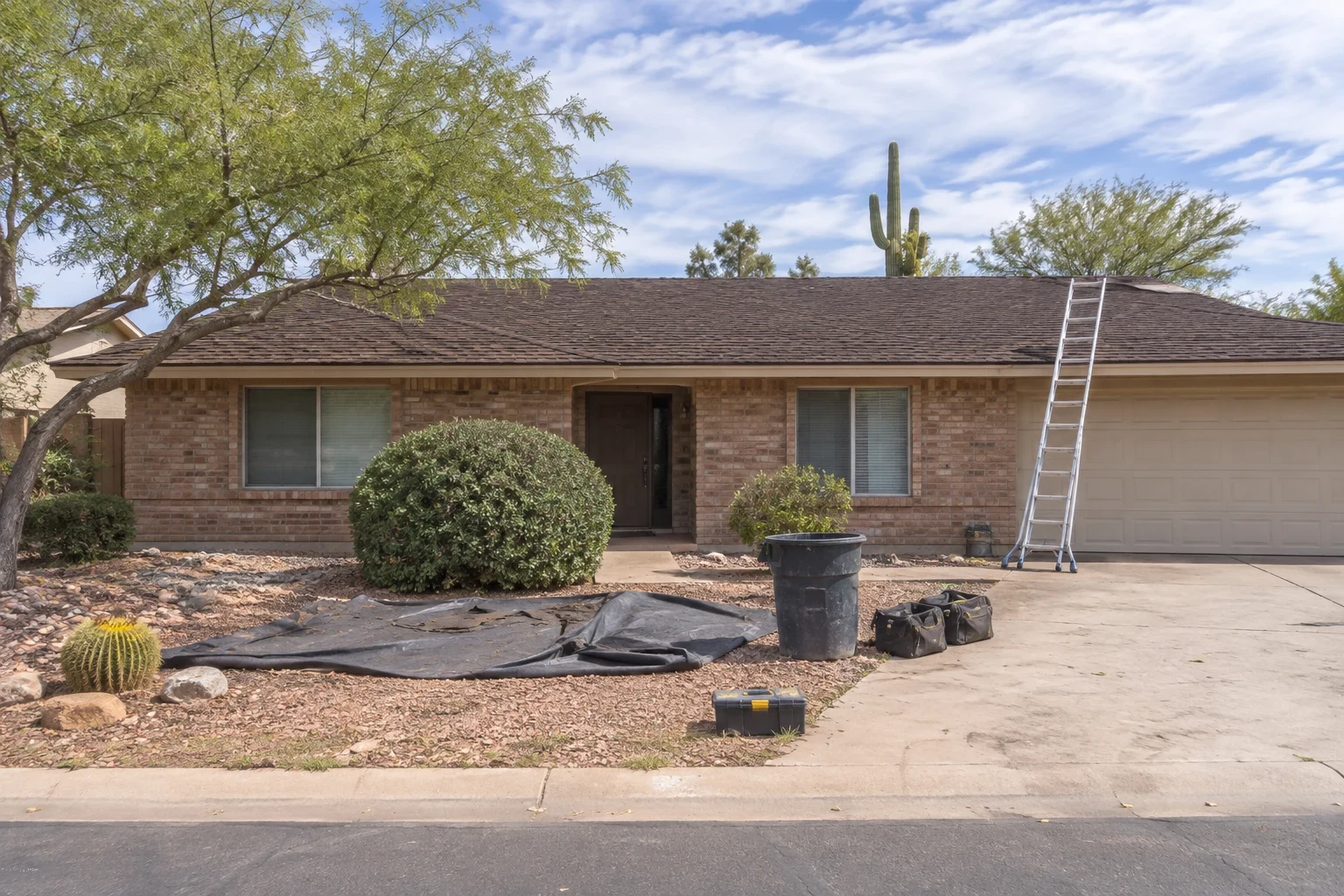
- Tarps shield plants and siding during tear-off. Before we leave, a magnetic sweeper goes over the driveway and yard to pick up stray nails.
Signs Your Shingles Need Attention
Grit collecting at the drip line
Dark, sandy grit piling up where water runs off the roof edge means the granule layer is shedding. Once the asphalt underneath is exposed, it ages fast.
Curling or cupped edges
When tab edges turn upward or the middle of a shingle dips, the asphalt has lost its flexibility. A raised edge gives wind something to grab, and stiff shingles snap rather than bend.
Missing or creased tabs
A straight crease across a tab means wind lifted it and folded it back, tearing it free of the adhesive strip below. It may look like it is still in place, but it is no longer sealed down.
Stains on the ceiling or in the attic
Brown rings or damp sheathing often lead back to a split pipe boot or loose flashing rather than the shingles themselves. Our Roof Repair page covers those targeted fixes.
Bare or brittle patches
If the fiberglass base is visible, or shingles crack when lifted, patching only buys a little time. At that stage Roof Replacement is usually the better use of your money.
What Moves the Price of a Shingle Roof
Shingle pricing depends on how much roof you have, what sits under the old layer and which product you pick. Each of those appears as its own line in writing, so you can compare item by item rather than guessing at one lump total.
Area and steepness
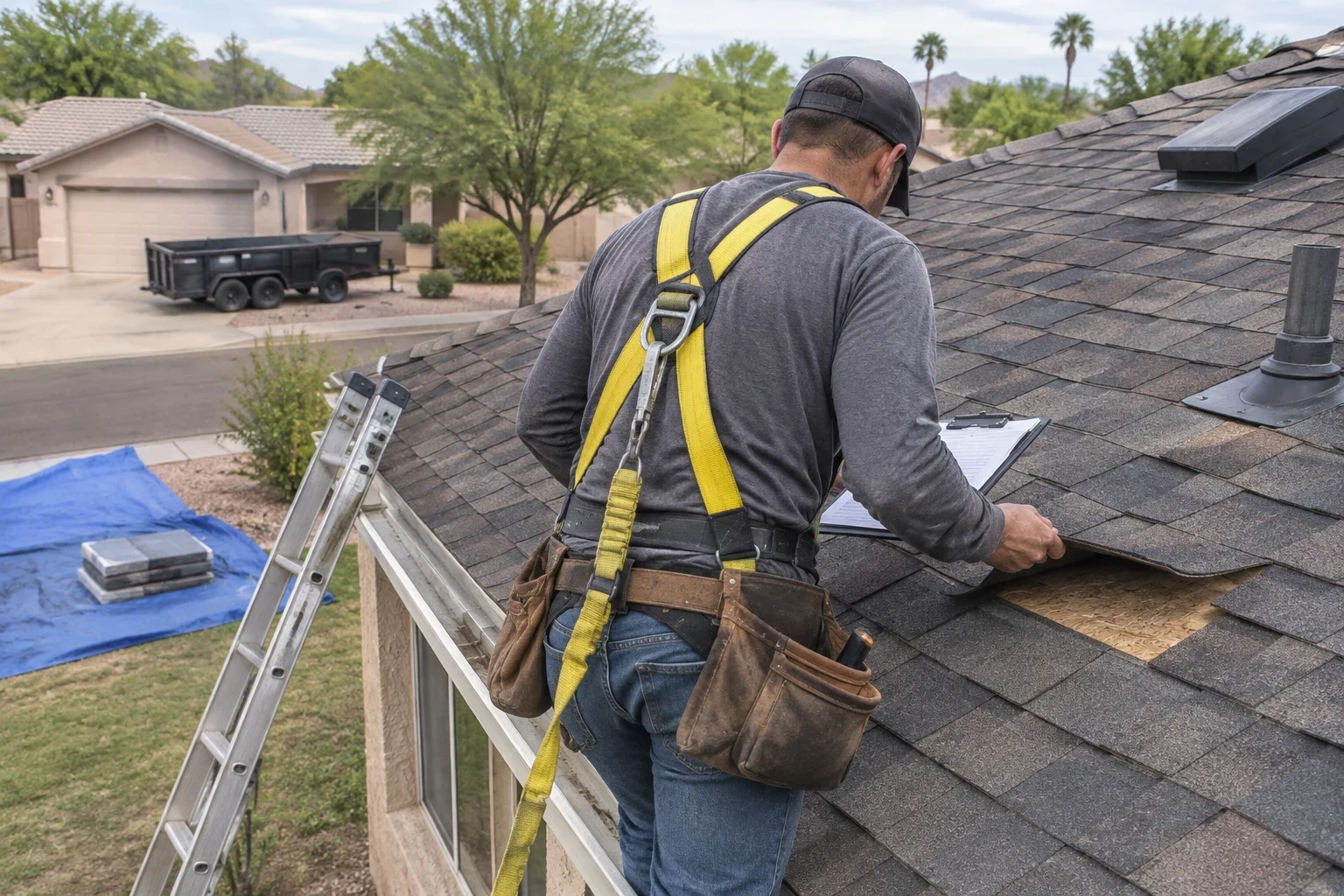
The number of squares on your roof decides how many bundles, rolls of underlayment and boxes of nails we order. On a steep pitch the crew works tied off with harnesses and moves more slowly, so labor climbs with the angle.
Number of layers
Two old layers take longer to strip and fill more dumpsters than one. Tear-off is listed separately so you can see that cost.
Decking condition
Plywood or OSB that is soft or peeling apart has to come out before new shingles can be nailed down. We set a per-sheet price in advance, so the number is fixed before anyone finds the damage.
Shingle line and color
Architectural shingles cost more than three-tab but hold up better in wind. Lighter, reflective colors can run higher and help keep attic heat down.
Flashing and ventilation upgrades
Adding ridge vent, replacing wall or chimney flashing, or changing the vent count each show up as their own item.
How a Shingle Job Runs
- 1
Roof and attic walk
We walk the roof, check the flashing and boots, and look in the attic for airflow problems and old water marks. We take photos so you see what we saw.
- 2
Your written quote
You get a line-item document listing materials, quantities, tear-off, flashing and vent work, plus a per-sheet price for any decking that turns out to be damaged. Nothing is added that is not on that page.
- 3
Permit and delivery
If your town calls for a permit on the job, we file for it ahead of the work date. Bundles arrive close to install day so they are not baking on the driveway for a week.
- 4
Tear-off and install
In summer we start at first light, because hot shingles go soft and scuff under foot traffic. Most single-story homes are torn off and dried in the same day.
- 5
Final walk-through
We go over the finished roof with you, match any replaced decking against the agreed unit price, and finish the nail sweep.
Shingle Roofing Questions
Do asphalt shingles hold up in desert sun?
They can, when the roof is built for the heat. Solid granule coverage, a lighter color and a well-ventilated attic all slow UV and heat damage. A shingle roof over a hot, stuffy attic will wear out noticeably sooner.
Is it okay to shingle over my existing roof?
Local code may permit one added layer, but we usually advise against it. A second layer hides deck problems, adds weight and leaves old flashing in service. We lay out both options in writing so you can decide.
What happens if you find bad decking after tear-off?
Your quote already carries a per-sheet price for decking. We show you the damaged area, replace only the sheets that need it, and charge that agreed rate.
My roof is fairly low. Can it still be shingled?
Shingles can go down to a 2:12 slope with a doubled underlayment. Below that, water drains too slowly between the courses, and a flat system such as foam or a membrane is a better fit.
How long will the work take?
Most homes in Carefree, Cave Creek and Scottsdale take one to three days, depending on size, layers and pitch. The roof is dried in at the end of every workday.
Get Your Shingle Scope in Writing
Tell us what you are noticing on your roof and we will arrange a visit. Every part of the job is listed on paper before any work begins.