ServicesFlat Roofing
Flat Roofing in Carefree
We repair, recover and replace low-slope roofs on parapet homes, using modified bitumen, TPO and reflective coatings. Before any work starts, you get a written quote that lists the system, the tear-off, the flashing details and every factor that sets the price.
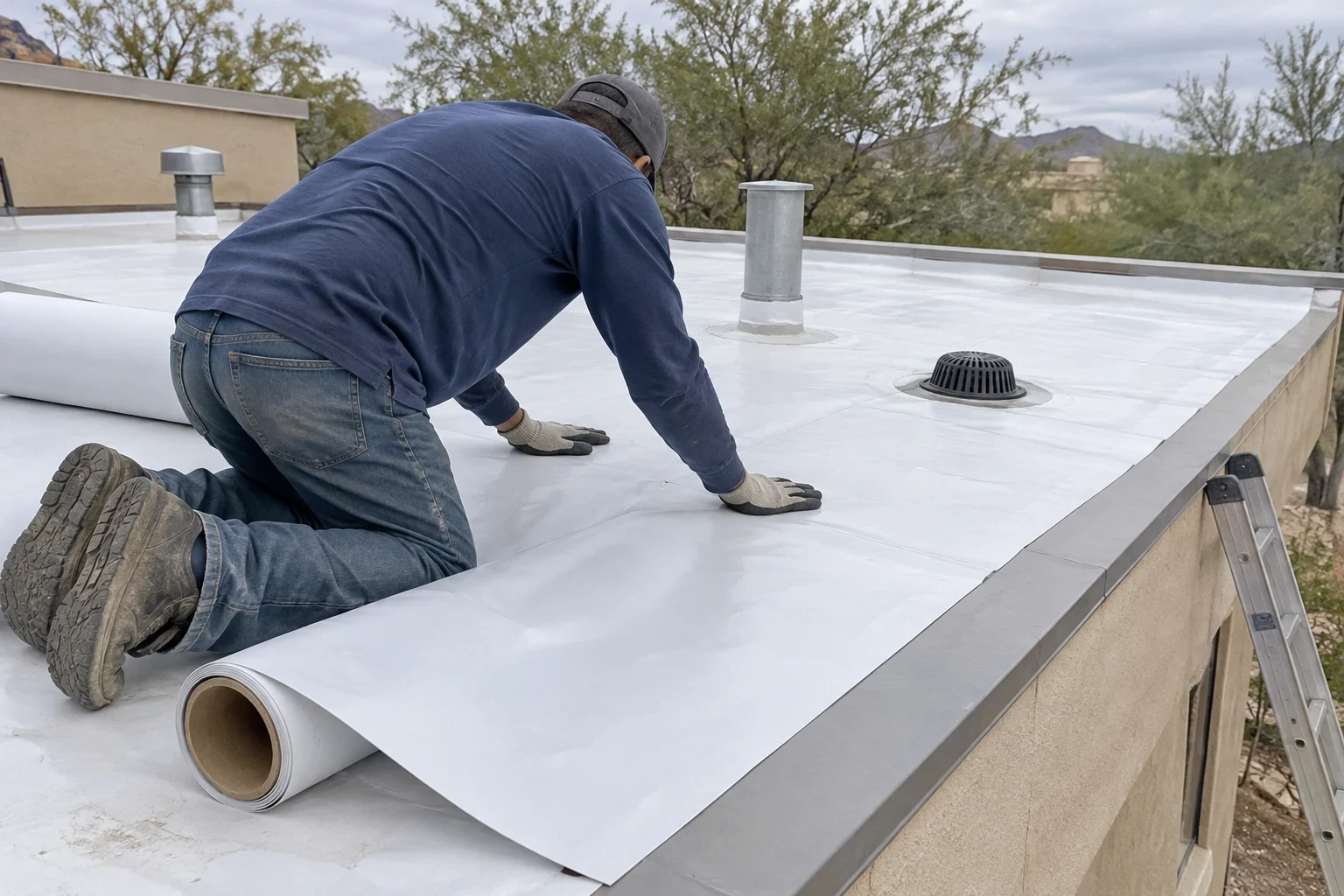
What Flat Roofing Covers and When It Makes Sense
A low-slope roof still needs fall, roughly a quarter inch per foot, to move water toward the scuppers or drains. Leaks usually begin where that pitch has been lost, or where the membrane turns up a parapet, wraps a vent or climbs onto an equipment curb. The open field of the membrane is rarely the first part to fail, so we spend most of our attention on those transitions.
Sun does most of the damage. Ultraviolet light bakes the oils out of asphalt-based materials, the surface crazes into a pattern called alligatoring, and the swing from hot afternoons to cool nights slowly pulls the seams apart. When monsoon storms arrive, any opening gets tested hard.
Flat roofing is the right call when your home has a parapet or low-slope section and the membrane is worn out, leaking at the edges or holding water after rain. Some homeowners also ask about spray polyurethane foam for the same kind of roof. The differences in upkeep, recoating and cost are laid out on our Foam Roofing page.
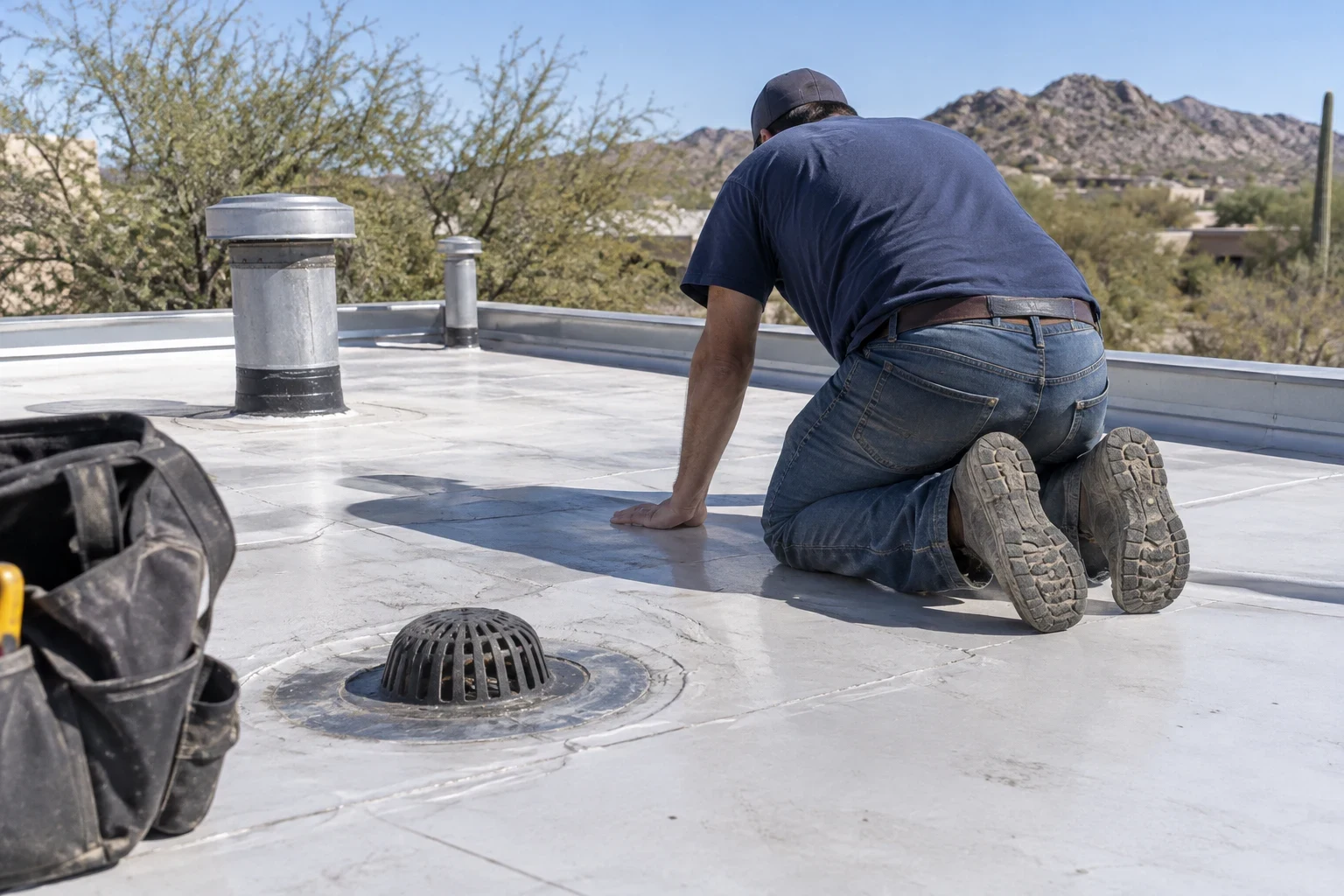
What the Work Includes
- 01
Membrane selection
We install modified bitumen, single-ply TPO, or an elastomeric coating over a sound existing roof. Each proposal names the exact system and explains why it suits your roof's condition and drainage.
- 02
Tear-off and deck repair
When old layers must come off, we remove them down to the deck and replace soft or delaminated sheathing. Rotted decking is listed in the estimate as a per-sheet item, so you know the cost before we find it.
- 03
Parapet and wall flashing
Membrane runs up the inside of the parapet and terminates under a cap or counterflashing. This transition between roof and stucco is where most flat roof leaks begin, so we treat it as its own line of scope.
- 04
Scuppers and drainage
We reline scupper boxes, reseal canales and add tapered insulation crickets where water sits behind a curb or against a wall.
- 05
Penetrations and equipment curbs
Plumbing vents, skylights and the curbs under air conditioners or evaporative coolers each get new boots or flashing tied into the membrane.
Questions about Flat Roofing?
Call(480) 672-5734Warning Signs on a Flat or Low-Slope Roof
Ponding that will not dry out
If a puddle is still sitting on the roof two full days after a storm, the deck has likely sagged or a scupper is partly blocked. That water ages the membrane faster and loads the deck with extra weight.
Blisters and bubbles
Raised pockets form when moisture or air is trapped between layers and expands in the heat. One small blister is minor; a field of them points to wet insulation underneath.
Cracked or alligatored surface
A dried, checkered surface on an asphalt roof shows the protective oils are gone. Once cracks reach the reinforcing layer, water follows.
Stains on ceilings near exterior walls
Leaks that show up along the edges of rooms usually trace back to a parapet flashing or a cracked cap, not the middle of the roof.
Seams lifting at laps
Open laps on modified bitumen or loose welds on TPO let wind-driven rain under the membrane. Edges that peel back by hand need resealing or replacement.
How a Flat Roofing Job Runs
- 1
Phone call
You tell us what you are seeing and roughly where. We set a time to come out and look at the roof in person.
- 2
On-roof assessment
We measure the roof and parapets, check the drainage path, probe for soft deck and photograph problem spots so you can see what we saw.
- 3
Written quote
You receive a line-item estimate covering the system, tear-off, flashing, drainage changes and any per-unit items like replacement decking. If the job requires a permit, it is listed and we pull it. Nothing gets added later without your sign-off.
- 4
Installation day
We protect landscaping and walkways, stage material, remove old layers in sections we can close up the same day, then install the new membrane and flashing.
- 5
Cleanup and final review
Old membrane and scraps get hauled away, and a rolling magnet goes across the yard and driveway to pick up stray fasteners. Then we show you the rebuilt scuppers and seams, on the roof or in photos.
What Sets the Price of a Flat Roof
Flat roof pricing comes from measurable things on your roof, not from a guess. Our written breakdown lists each of them separately so you can compare options and see exactly what you are paying for.
- Area and parapet length
- Square footage sets material, but linear feet of parapet often matters as much, since every foot of wall needs flashing and a termination detail.
- Layers and deck condition
- Removing two or three old roofs costs more than one, and wet insulation or rotted sheathing must be replaced before a new membrane goes down.
- System choice
- A coating over a sound roof, a modified bitumen roof and a TPO membrane each carry different material and labor costs and different lifespans.
- Drainage corrections
- Tapered insulation, new crickets or enlarged scuppers add scope but fix the ponding that shortens a roof's life.
- Rooftop equipment
- Units that must be lifted, disconnected or set on new curbs add labor, and we spell out how that work is coordinated.
Flat Roofing Questions
Which is better for a flat roof here, TPO or modified bitumen?
Both work well when installed correctly. White TPO reflects heat and has heat-welded seams, which suits roofs with few penetrations. Modified bitumen is thicker and tolerates foot traffic and complex detailing better. We explain which fits your roof and why in the written scope.
Can you coat my existing roof instead of replacing it?
Sometimes. A coating only makes sense when the existing membrane is dry, well adhered and draining properly. If we find wet insulation or widespread blistering, coating over it traps the problem, and we will tell you that plainly.
What happens to my air conditioner or cooler during the job?
Units on curbs usually need to be raised so the membrane and flashing can run underneath. The estimate says whether that is required and how it will be handled, so it is not a surprise on installation day.
How long does a flat roof replacement take?
It depends on the area, the number of layers coming off and how much deck repair is needed. We give you an expected schedule along with the estimate and close up each section we open before the end of the day.
Why does water pond on my roof when it is supposed to drain?
The deck may have deflected over time, a scupper may be undersized or clogged, or the original roof was built with too little slope. We find the cause and include the fix, such as tapered insulation or a reworked scupper, as its own line item.
See Your Flat Roof Scope on Paper
Tell us what is happening on your roof and we will set a time to measure it. You get a written quote that spells out the system, the details and the cost factors before anything starts.